
Liquidity Forecasting and Actively Managing Payment Outflows
From Liquidity Insight to Controlled Settlement
Intraday liquidity outcomes are increasingly determined by how effectively settlement behaviour is controlled throughout the day.
Baton’s liquidity forecasting and dynamic payment outflow controls use live data and continuously updated liquidity projections to drive settlement decisions.
By combining expected inflow and outflow timings, projected liquidity positions and real-time settlement progress, institutions can:
- Stabilise settlement flows as conditions evolve
- Minimise peak liquidity usage
- Lower funding costs
- Improve capital efficiency
Modular Deployment. Incremental Adoption. Extendable by Design
Speak with a Baton Intraday Liquidity Specialist
Discuss how precision forecasting and more actively managing payment outflows could benefit your institution.
An Integrated Framework
for Real-time Liquidity Control
Baton connects intraday liquidity insight directly to settlement execution. Institutions can deploy individual capabilities such as real-time monitoring, payment matching, multi-horizon liquidity forecasting and active outflow management independently, then extend coverage as needs evolve.
Liquidity forecasting and outflow management modules work together to govern the conditional release of payment instructions. Decisions are based on reconciled inflows, projected liquidity positions, payment priorities and real-time constraints – optimising liquidity through prioritisation, sequencing and throttling across currencies and entities.
At scale, Baton acts as a real-time decision and coordination layer, linking treasury and risk systems with traditional and digital payment rails to connect insight directly to execution across the payment lifecycle.
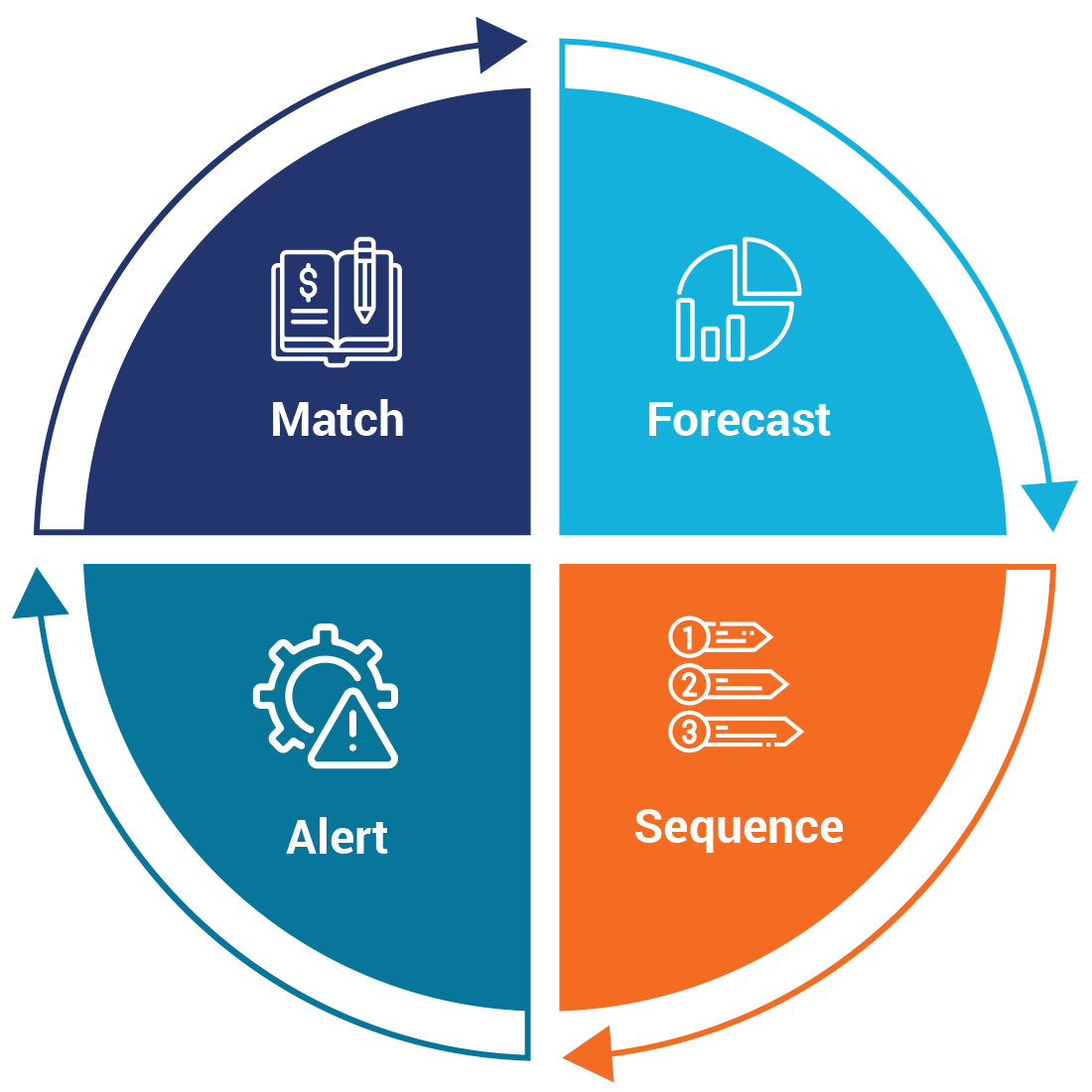
With Baton, real-time liquidity decisions are continuously informed, and driven, by live execution and reconciled data:
-
- Start-of-day forecasts are calculated by combining anticipated exposures, outstanding and counterparty, and currency-specific, historic payment behaviours
- Real-time payment matching and settlement progress continuously update liquidity projections anticipating emerging funding pressures and dynamically adjusting how payment outflows are managed
- Sequencing and throttling decisions feed back into forecasts, refining expected positions as payments are released or deferred
- Alerts and anomaly detection surface deviations from expected behaviour, allowing for the recalibration of intraday projections, sequencing and throttling decisions
Each settlement event informs the next decision, enabling liquidity to be actively managed throughout the day and stabilised under stress.
Capital and Regulatory Impact
Precision liquidity forecasting and active outflow management directly shape capital efficiency, funding requirements and resilience. By stabilising settlement behaviour and reducing peak liquidity pressure, institutions can:
Actionable Foresight for Intraday Liquidity Control
Baton’s liquidity forecasts provide treasury teams with an accurate, granular view of expected net outflows, peak liquidity usage and emerging funding pressure points across intraday, end-of-day and next-day horizons.
Liquidity forecasts are recalibrated intraday as conditions change, ensuring funding and settlement decisions are based on current expected liquidity outcomes.
The Result: Earlier visibility of funding pressures – enabling reduced peak net outflows, lower external borrowing and more efficient liquidity use.
Baton’s forecasts are driven by a rich, reconciled data set that reflect how liquidity actually behaves during the day, including:
- Historical counterparty settlement behaviour: Predicts likely inbound payment timings based on observed patterns and probabilities.
- Scheduled obligations and priorities: Includes mandatory Time-Specific Obligations (TSOs) and other priority payments with known timing constraints.
- Live balances and in-flight activities: Current balances, reconciled cashflows and payments currently being executed.
- Real-time variance tracking: Tracks divergence between expected and actual flows and timings, feeding back into forecast accuracy as the day unfolds.
This combination ensures forecasts remain both forward-looking and grounded in real-time settlement data.
The result is liquidity forecasting that treasury teams can actively rely on:
- Continuous recalibration: Forecasts update automatically intraday as payments settle, inflows arrive or conditions shift.
- Granular, decision-ready views: Forecasts are available by currency, legal entity, counterparty, product and intraday time bucket.
- Confidence under BAU and stress: Detailed and precise projections that can be used to confidently support funding, sequencing and settlement decisions, even during volatile or stressed conditions.
The real-time data layer behind Baton’s advanced forecasting and dynamic outflow management capabilities
Baton’s monitoring tools unify live and historical liquidity data providing a verified foundation to power accurate liquidity forecasting and controlled payment execution.
How Baton Supports ECB Sound Practices for Liquidity Forecasting
Principle 3 of the ECB Sound Practices for Managing Intraday Liquidity Risk requires institutions to forecast intraday liquidity needs, taking into account upcoming payments, priorities and settlement timings, with projections updated continuously throughout the day.
Baton provides accurate liquidity forecasting that supports these expectations, enabling institutions to:
- Forecast intraday, end-of-day and next-day liquidity positions based on forthcoming payments, their priorities and expected settlement timing
- Identify and embed time-specific obligations (TSOs) and priority payments directly into projections
- Continuously recalibrate forecasts using a rich reconciled data set, including live balances, inflows, outflows and real-time expected vs actual variance tracking
- Incorporate historical counterparty settlement behaviours and timings to improve forecast accuracy
- Identify emerging liquidity pressure points early, including large transactions, short-horizon net outflows and projected largest negative net cumulative position (LNNCP)
The result is continuously updated liquidity forecasting grounded in reconciled real-time and historical data, enabling institutions to accurately anticipate intraday funding needs and proactively manage intraday liquidity risk.
Controlled Payment Release Driven by Accurate Forecasts and Real-time Data
Baton enables real-time, controlled management of payment outflows that aligns settlement activity with actual and expected liquidity conditions throughout the day.
Intraday liquidity forecasts, combined with real-time balances, settlement updates and configurable rules are used to determine when and how payment instructions are prioritised, sequenced or throttled.
The Result: Controlled, predictable settlement that reduces peak liquidity usage, lowers reliance on intraday credit and strengthens resilience.
Payment initiation is continuously informed by a consolidated, real-time view of:
- Expected liquidity positions and timings from intraday forecasts
- Confirmed inflows and real-time settlement status
- Payment priorities and obligations incorporating Time-Specific Obligations (TSOs), priority payments, cut-offs and throughput requirements
All release decisions are driven by configurable rules, creating a transparent and auditable process with defined human override controls.
This approach enables treasury and operations teams to:
- Dynamically optimise payment sequencing as liquidity conditions evolve
- Prioritise TSOs while deferring less urgent flows
- Throttle or hold lower-priority payments when balances fall below defined thresholds
- Release payments conditionally as forecasted or confirmed inflows materialise
- Manage payment release within credit line constraints,
supporting reduced intraday borrowing and funding costs
How Baton supports ECB Sound Practices for Managing Outflows
The ECB Sound Practices for Managing Intraday Liquidity Risk expect institutions to actively manage payment outflows so TSOs settle on time, while other payments are prioritised within available liquidity under BAU and stressed conditions.
Baton provides real-time intraday payment outflow management, enabling institutions to:
- Establish an outflow ladder, prioritising TSOs and other critical payments
- Define BAU liquidity buffers and escalation alerts for treasury and risk teams
- Release payments using rule-based controls in combination with forecasts and live settlement settlement status
- Dynamically prioritise, sequence or throttle payments based on pre-defined conditions
- Protect priority payments under stress, reserving liquidity capacily for TSOs and other priority payments
- Actively manage payment outflows across currencies with full transparency and auditability
This enables predictable, controlled payment flows, supporting ECB expectations, emerging intraday liquidity risk management regulatory requirements in other jurisdictions, and improving liquidity efficiency and resilience.
Designed for Institutional Environments
Baton is designed for live, regulated environments where liquidity decisions must be controlled, explainable and resilient.
Built for banks and non-banks operating at scale across multiple currencies, legal entities and settlement infrastructures, Baton enables real-time control with auditability and regulatory confidence.
Baton operates as a real-time coordination layer, linking treasury insight, risk constraints and payment execution across existing systems and rails.
Institutions retain full control over how decisions are applied. They can:
- Execute sequencing, prioritisation and throttling directly within Baton, or
- Publish priorities, flags and recommendations to upstream or downstream systems
Designed to work across existing infrastructures, Baton is interoperable and extensible, allowing decisioning and execution to be placed where it best fits without restructuring core systems.
Baton’s approach to implementation is designed to deliver value incrementally, without requiring upstream system changes or a full operating model redesign before benefits are realised.
It is cloud-native and securely deployed as an overlay, not a rip-and-replace platform. Integration follows established enterprise standards – reducing implementation effort and accelerating time-to-value.
Institutions can adopt forecasting and managing payment outflow capabilities proportionally, starting with the currencies, entities or flows where intraday risk is most material, and expand capabilities over time without having to re-work earlier integrations or deployments.
Baton is designed to support both targeted intraday liquidity controls and high-volume, multi-currency operations using the same cloud-based scalable architecture designed for resiliency and high availability. As requirements evolve, capabilities can be easily extended without disruption to existing processes or controls.
This means:
- Forecasting logic, sequencing rules and workflows can be adjusted through configuration, not re-engineering
- Higher transaction volumes are supported without operational rework
- New rails, data sources, payment types and workflows can be introduced incrementally
- Scaling across accounts, currencies, and legal entities does not require re-architecture
- Regulatory and policy changes can be reflected quickly and safely
This allows institutions to address immediate intraday liquidity risks with a scalable and resilient platform, able to support business growth and evolving supervisory expectations.